
Where Kentucky DOC Releases Go
Kentucky DOC manages sentenced-offender records across state institutions and a county-jail state-inmate program. A person leaving secure custody may enter parole, mandatory reentry supervision, another jurisdiction, or the community at sentence completion. A movement from Marshall County Detention Center to a state prison is a transfer, not a community release. Likewise, parole means the person is outside the prison under conditions while the sentence remains active. Final discharge is the stronger event that closes the correctional or supervision obligation shown by DOC.
Release Terms in the State Record
Parole is conditional release authorized by the Kentucky Parole Board. Mandatory reentry supervision is a statutory supervised period under KRS 439.3406. Transfer continues custody at a new location. Discharge means the applicable sentence or supervision obligation has ended.
These distinctions matter in Marshall County because the local detention center can hold state Class D inmates, controlled-intake prisoners, and parole violators. The building alone does not identify which government system controls the release. Read the person’s legal status and offender record before drawing a conclusion.
How to Confirm a Kentucky DOC Release
The principal public route is Kentucky Offender Online Lookup, known as KOOL. It is designed for state correctional records, not every local pretrial booking. Use a DOC number when available because it is more reliable than a common name.
- Search KOOL. Enter the DOC number, or begin with surname and given name. Add identity criteria carefully rather than over-filtering the first search.
- Verify identity. Compare name, aliases, DOC number, age or birth information, offense record, and county information before relying on a result.
- Separate the dates. Read Projected Release Date, parole eligibility, sentence expiration, actual release, supervision, and discharge as different fields.
- Read status and location together. A county jail may be the physical location of a person already under state correctional authority.
- Confirm the event. Use the Parole Board record for a claimed parole grant, District 1 for supervision routing, or a DOC records response for an archival or unclear status.
A projected date estimates a future event. It does not prove that a Kentucky DOC release happened or that another custodian did not take control.
The official KOOL FAQ says public data updates four times daily while warning that recent data may still be corrected. Capture the displayed context date and exact label. If a former offender no longer appears, the research directs inquiries to Offender Information Services, P.O. Box 2400, Frankfort, KY 40602-2400, at 502-564-2433.
Marshall County State-Inmate Daily Releases
Marshall County has an unusual state-record route because its detention center participates as a Restricted Custody and Class D facility. A state offender can physically leave the Benton jail and appear in an official KY DOC Daily Releases report. That can occur even though Marshall County publishes no verified rolling county release list.
The state report can include a DOC number, name, type of release, releasing facility, and offender class. An official report from November 25, 2025 contains a Marshall County Detention Center example. This is useful evidence for the state-inmate subset, but it is not a complete list of everyone leaving the county jail. Local pretrial detainees and county-only cases may never enter DOC’s statewide release reporting.
| Report Field | What It Helps Confirm |
|---|---|
| DOC number | Connects the report row to the correct state offender. |
| Type of release | Distinguishes the state’s coded release path from a mere location change. |
| Released from | Identifies the physical institution or county facility tied to the event. |
| Offender class | Explains why a state offender may have been housed in a county facility. |
This Marshall-specific state-inmate route is supplementary. For a complete answer, reconcile the report with the individual KOOL record and any court, parole, or supervision material.
Why Kentucky DOC Release Dates Change
A projected release date is a computed estimate based on the sentence record as it then exists. Court-awarded jail credit, statutory credits, disciplinary changes, parole action, detainers, later convictions, court amendments, and offense-specific limits can alter the calculation. KRS 197.045 addresses sentence credits, while KRS 439.3401 imposes minimum-service rules for covered violent offenders. Offense date and statutory amendments can change which rule applies.
The KOOL detail page may separately display Minimum Expiration of Sentence Date, Expected Time to Serve, Parole Eligibility Date, Maximum Expiration, and parole hearing information. Those labels are not interchangeable. “Projected” should never be rewritten as “scheduled” or treated as a promise.
The Kentucky General Assembly publishes the controlling statutory text. Its Chapter 439 page provides the legal context for parole and mandatory reentry:
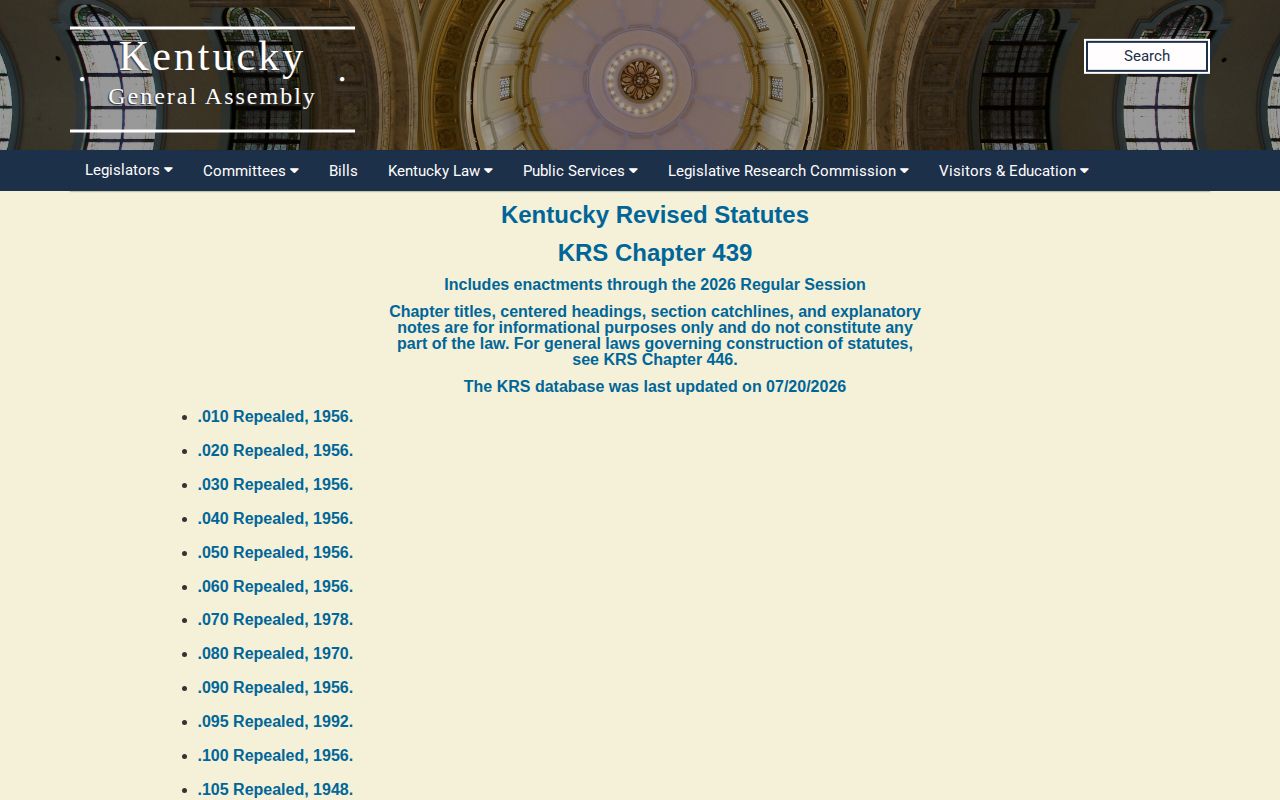
The image shows the official statute source rather than an unofficial release calculator. An individual computation still requires the current sentence documents and the law that applies to that person.
Parole, Supervision, and Actual Release
The Kentucky Parole Board makes parole decisions, while the Kentucky Department of Corrections Division of Probation and Parole manages field supervision. The Board conducts eligibility hearings weekly, publishes schedules monthly, and refreshes schedule files on Monday mornings. An eligibility list may show an offender name, DOC number, location, eligibility timing, conviction county, and offense information, but it is not a release list or a final decision.
A grant authorizes parole subject to an effective date, conditions, and other barriers. A denial does not authorize release. A deferred or continued matter is still pending, and a rescinded action may remove a previously expected release. A revocation concerns supervision failure after release and can return a person to custody. Check the Board record, then confirm actual movement through KOOL or DOC records.
Marshall County is served by Probation and Parole District 1. The current office page says Benton staff moved to the Murray satellite at 304 North Fifth Street, Murray, KY 42071. The listed numbers are 270-753-7980 and 270-527-3515. Staff can route a caller and explain process, but public disclosure of individual case-management details may be limited.
VINE Notifications for Kentucky State Offenders
Kentucky participates in VINE through VINELink. Search for one person, match the reporting agency and identifiers, and read the custody status and last-update time. If the verified record offers release or custody-change notices, registration may be available by telephone, text, email, or app. The available choices on the live record control.
A VINE alert is secondary evidence. It can indicate that the reporting agency no longer lists the person in its custody, but it may omit the release authority, destination, or immediate pickup by another agency. Preserve the reporting agency and alert time, then confirm the release in KOOL or with DOC. Delays can result from agency data entry, participation, or telecommunications.
Kentucky DOC Records and Contact
When KOOL does not resolve an old record or the meaning of a release field, request the existing DOC record from the Department’s current open-records custodian. Ask narrowly for sentence and release data, the release certificate or status record, and the correctional photograph only if publicly disclosable. A court judgment or sentencing order belongs with the court clerk, not DOC.
Kentucky DOC Offender Information Services
Mail: P.O. Box 2400
Frankfort, KY 40602-2400
Phone: 502-564-2433
Public lookup: Kentucky Offender Online Lookup
Kentucky’s Open Records Act is found mainly in KRS 61.870 through 61.884. KRS 61.872 governs access and request mechanics, KRS 61.874 addresses copies and reasonable fees, and KRS 61.880 generally requires a written agency response within five business days. Exempt, sealed, expunged, medical, juvenile, victim, security-sensitive, and other protected information may be withheld or redacted. Ask for segregable nonexempt portions instead of protected details.
About the Kentucky DOC System
Kentucky DOC is a statewide sentenced-offender system, not a Marshall County jail. Its public record can follow a person from a state institution or county-jail state-inmate placement into parole, mandatory reentry supervision, and discharge. KOOL can show a county jail as the physical location without changing the person’s state correctional status.
This division of responsibility explains why the Marshall County release search guide begins by identifying the last legal custodian. County release records are best for county-only detainees. KOOL and DOC records are best for state offenders. Federal and immigration transfers require the receiving federal system. Using the correct owner avoids treating a roster disappearance as proof of freedom.